How I map out four beds, sow everything direct, and let worm castings do most of the work.
{This post contains affiliate links. If you make a purchase through one of these links, I may earn a small commission at no extra cost to you. I only link to things I actually use and love in my own garden.}
There’s a particular kind of joy that settles in around March — the seed catalogues are dog-eared, the soil is still cold, but the planning has already begun. After eight seasons of growing vegetables in the Midwest, I’ve learned that the garden year doesn’t start the moment I push my first seeds into the earth. It starts at the kitchen table, with a sketch and a cup of coffee — months before the first cool-season crops go in around late April, with planting stretching all the way through my warm-season crops in July.
I also use this quiet planning time to set an intention for the season. I think of it less as a goal and more as a guiding idea — something to orient the whole year around. Last year it helped me stay focused. This year’s intention came to me quickly.
THIS YEAR’S INTENTION: “Grow enough greens that I never have to buy salad greens at the store.”
It sounds simple, but it means something. Grocery prices have been relentless — a clamshell of mixed greens that used to cost a few dollars now costs nearly double. Growing my own is good for my body and, increasingly, good for my bank account too. I want to walk to the backyard instead of the produce aisle, all season long.
This year I’m keeping the layout I’ve refined over the last few seasons: two raised beds at 3.5 by 6 feet, one lower ground bed at 3 by 7, and a larger 3-by-15-foot ground space that I dedicate entirely to a Three Sisters planting. Each space has its own rhythm and its own crew.
MY RAISED BED SETUP
If you’re starting from scratch, here’s what I used:
-
- DIY raised garden bed plans — the exact dimensions I scaled for my 3.5×6 ft beds
-
- Vego metal kit — easiest option if you’d rather skip the cutting
-
- Heavy-duty trellis panels — what my pole beans and peas climb
The Cool-Season Beds
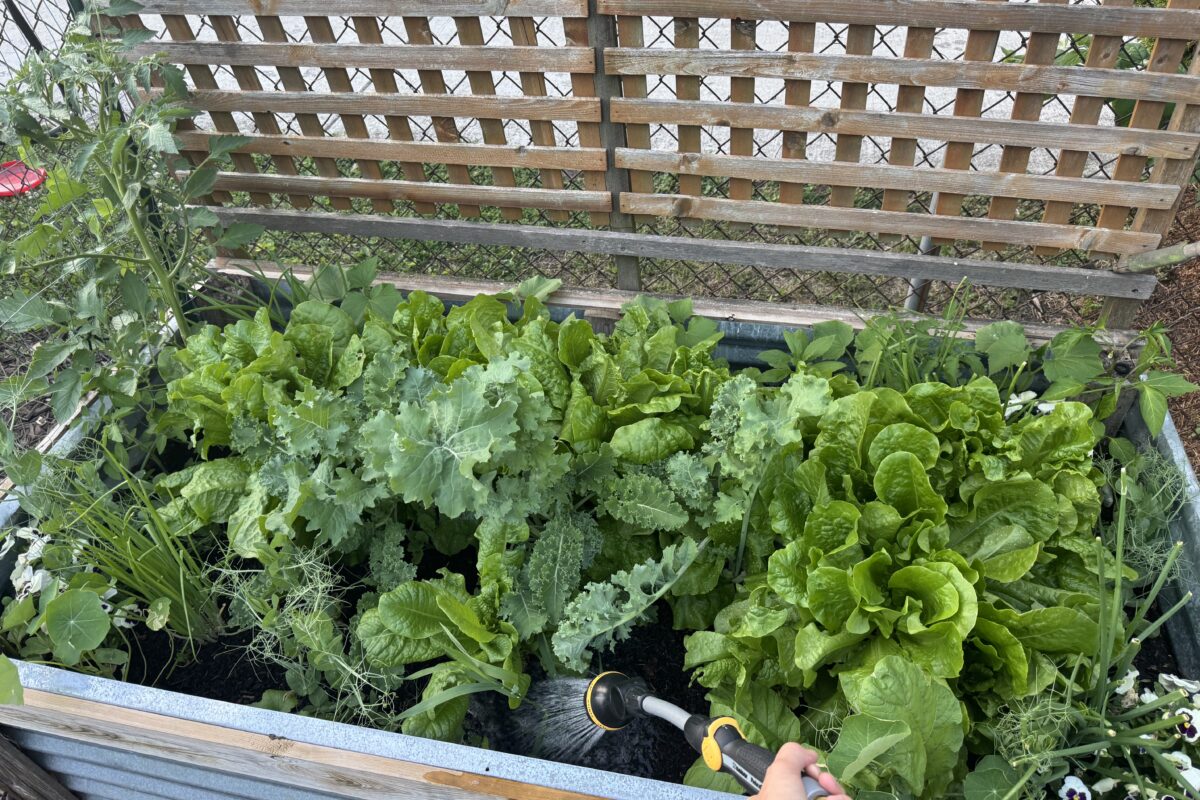
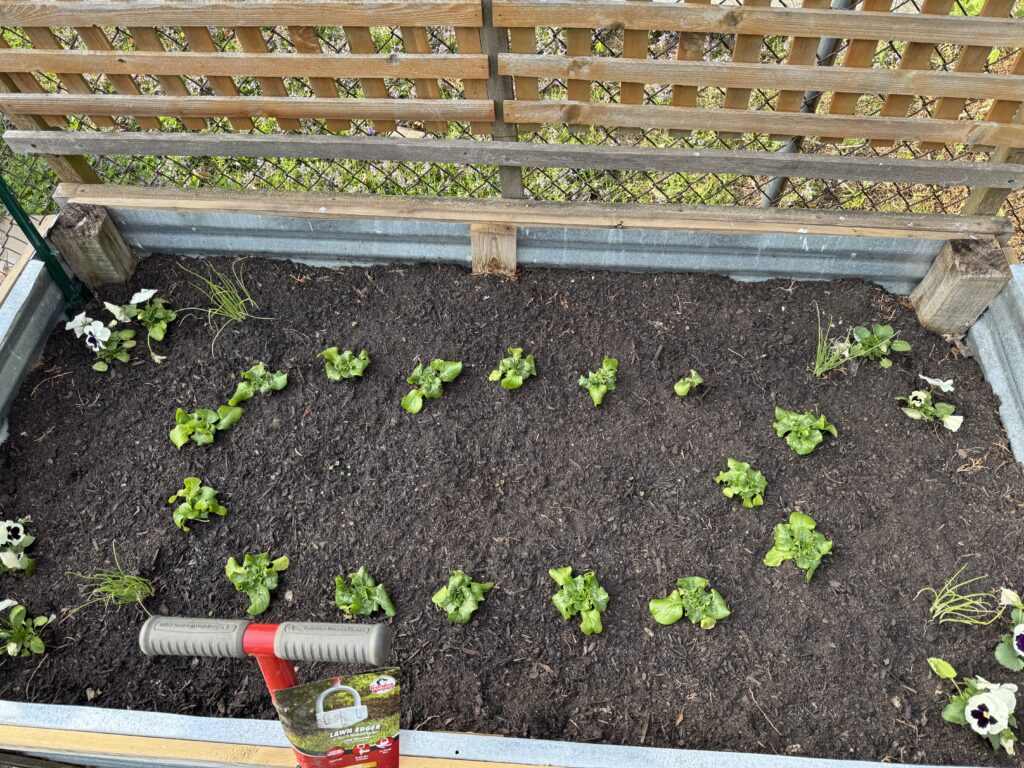
My two raised beds belong to the cool crops — and this year they’re the heart of my greens intention. Come late April, I sow Buttercrisp lettuce seeds, parsley, beets, kale, and Swiss chard. These are hardy, forgiving plants that actually prefer a bit of a chill. Cilantro joins them in early May, once the threat of a truly hard frost has passed.
My lower bed gets broccoli, cauliflower, spinach, and carrots. I weave garlic throughout all of my beds — it’s my first line of defense against pests, quietly doing its work between every other plant. Dill goes in too, partly because I love it, partly because it attracts beneficial insects that do the pest management I can’t.
RAISED BED 1 & 2
3.5 × 6 ft each
Buttercrisp lettuce · Parsley · Beets · Kale · Swiss chard · Cilantro (May) · Garlic · Dill
LOW BED
3 × 7 ft
Broccoli · Cauliflower · Spinach · Carrots · Garlic (throughout)
TRELLIS BED
Low ground bed
Pole beans · Peas · Green onions (perennial) · Rosemary · Sage
3 SISTERS GROUND
3 × 15 ft
Corn · Sunflowers · Squash · Zinnias along the front
The Three Sisters — and Their Sunflower Cousins
My largest space is reserved for the Three Sisters method: corn, beans, and squash planted together in the tradition of Indigenous American agriculture. The corn grows tall and gives the beans something to climb; the beans fix nitrogen back into the soil; the squash sprawls low, shading out weeds and holding moisture. It’s one of the most elegant companion-planting systems ever developed, and it works. (Midwest Tip: cover with lightweight row cover until sprouts are 3 inches tall)
I add sunflower seeds to the mix — they soar alongside the corn and bring pollinators in from the whole neighborhood. And along the very front edge of this bed, I line up zinnias. They’re cheerful, they cut beautifully, and they keep pollinators busy right where I need them.
This is also the bed where my four kids tend to gravitate. There’s something about the scale of it — the tall corn, the big sprawling squash, the drama of a sunflower taller than they are — that captures their imagination. They love helping in the garden. The joy of pulling a squash off the vine or snapping a bean never seems to get old for them, and makes me proud that they know where their food comes from.
Feeding the Soil, Not Just the Plants
I don’t use synthetic fertilizer. Full stop. My soil is built on compost — sourced locally from a supplier who works with regional farms — and my secret weapon is worm castings. I mix them into the soil at planting time, nestling seeds directly into them, and then I continue adding castings throughout the growing season as a gentle, ongoing soil feed.
This year I’m trying something new: adding coarse horticultural sand to my compost mix. My beds hold moisture well — sometimes almost too well after a heavy rain — and I’m hoping the sand helps open things up and keep that moisture level more consistent without waterlogging the roots.
SOIL TIP
Mix worm castings directly into the planting hole or seed furrow so germinating seeds are surrounded by nutrients from the very first day. Top-dress with more castings every few weeks as the season progresses. I use a small hand trowel to work it into the soil without disturbing roots.
Direct Sowing — All the Way This Year
For years I split my effort between starting seeds indoors in March and direct sowing outside. This year I’m going all-in on direct sowing. Last fall was unusually warm, and I had great results direct-sowing late in the season. That success gave me the confidence to trust the soil more and the grow lights less.
There’s something freeing about it. No trays of seedlings crowding the windowsill, no hardening-off process, no transplant shock. Just seeds in the ground, covered with a little worm-casting-enriched compost, and time.
Keeping Watch
Every week I make my rounds. I lift every large leaf in every bed and check the undersides for caterpillars and aphids. If I find one, I relocate it — far to the front yard, well away from the vegetables. I cover my broccoli bed with lightweight insect netting as a physical barrier against pest pressure; aphids and cabbage moths are the main culprits there, and the net stops them before they ever become a problem.
I water at the soil level only — no overhead watering, which can encourage fungal disease. And once my carrots germinate, I thin them decisively. It’s counterintuitive to pull out seedlings you worked hard to grow, but crowded carrots stay small. Giving them space is the whole game.
Once the real heat of summer arrives, the warm-season crops go in: tomatoes and cucumbers. By then the cool crops have done their work, the beds have been refreshed with compost, and a new chapter of the garden begins.
Eight years in, and I still look forward to this — the planning, the sowing, the weekly checks, and yes, occasionally the less-than-peaceful pest removal. The garden teaches patience and pays it back in full every summer. This year, with four enthusiastic little harvesters by my side and a produce aisle I’m determined to skip, I think it’s going to be the best season yet.
Happy Growing!
Gardening method influenced by trial and error; books and Gardenary, Deep Roots; Local compost & worm castings from a regional farm supplier.